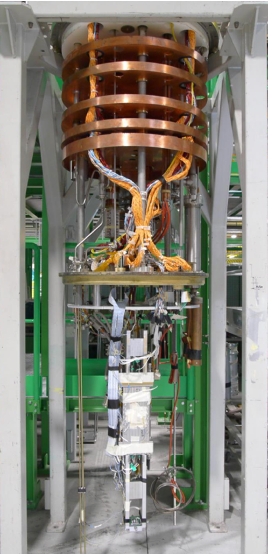
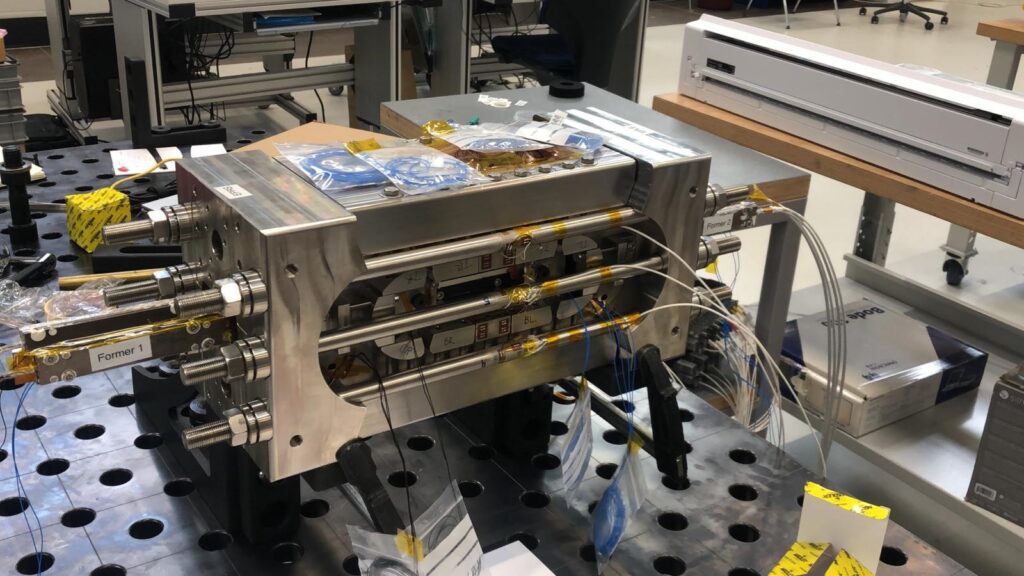
The subSMCC2b magnet is PSI’s second Nb₃Sn subscale magnet of common-coil type with two apertures, and represents an important milestone for the technology development for a 14 T demonstrator magnet for FCC.
Building on the subSMCC1 design, subSMCC2 was developed to validate the Energy Shift with Coupling (ESC) protection method based on fast-pulsed auxiliary copper coils. The rapid current transient generated in these coils induces a strong magnetic-field transient that quickly drives the superconducting coils into quench. Once the quench is initiated, the stored magnetic energy is dissipated as heat in both, the superconducting coils and the magnetically coupled copper coils, enabling a fast discharge of the magnet’s stored energy and ensuring a low peak temperature and peak voltage. This, in turn, allows magnet designers to create more compact and efficient designs.
The test campaign was carried out in liquid helium at CERN, where the magnet reached its short-sample current of 8.9 kA without training. This corresponds to a bore field of 4.9 T.
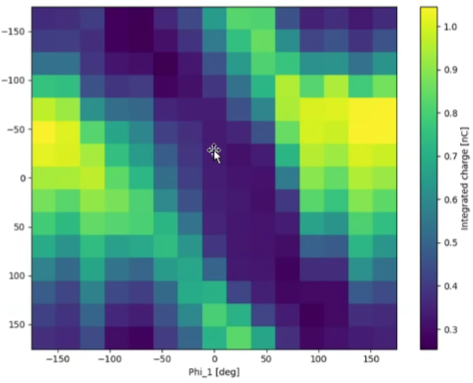
The test of subSMCC2b constitutes the first demonstration of ESC-only protection.
Magnetic measurements also showed good agreement between the measured and simulated field-harmonic components.