About CHART
The next collider at CERN is a Swiss national science priority. To support this goal, the Swiss government and academic institutions partnered with CERN to create CHART—an umbrella organization for Swiss research collaborations dedicated to accelerator science and technology for the Future Circular Collider (FCC).
Focus areas
CHART concentrates its work in four areas:
- Accelerator systems — the FCC-ee injector complex above all: electron and positron sources, linacs, capture and damping
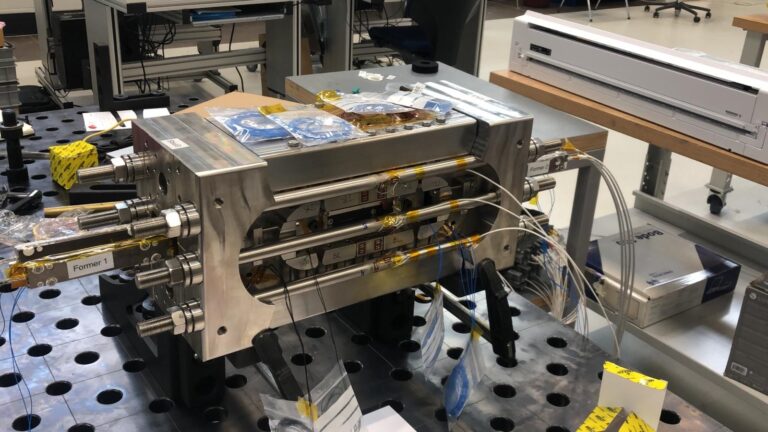
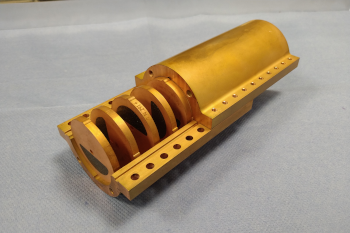
- Magnets and superconductors — high-field magnets for a future hadron collider, high-performance Nb3Sn wires, and high-temperature superconducting magnets that make accelerators
more compact and sustainable - Beam dynamics — how beams behave in a collider: luminosity, stability, collective effects, polarization
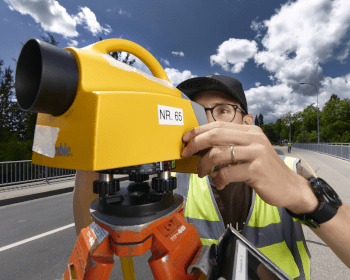
- Geology and geodesy — the ground the FCC tunnel would pass through, and the reference frames needed to align a 91 km machine
Mission orientation
Mission-oriented research is defined as a work aimed at pre-defined societal or technological goals, pursued to measurable targets within a binding timeframe. CHART applies that logic to accelerator research: the Council fixes the direction, focus areas, and strategic investments, and the teams produce project proposals with this frame:
- The CHART Council reviews every proposal for its fit with the mission
- Common funds from SERI and the ETH Board allow investment in topics of high strategic value, which no single institution would carry alone
- Funding runs in four-year periods, so each renewal is an opportunity to steer
- The organisational umbrella gives the research continuity across those periods
- Projects are interconnected across the focus areas, so each reinforces the others
- CHART is open to collaboration with partners worldwide
“The Swiss Accelerator Research and Technology (CHART) programme is a good example of a mission-oriented programme. It aims at supporting the Future Circular Collider at CERN. In this case the receiver of the results is CERN. Such initiatives benefit both science and Switzerland.”
Highlights


Synergies
CHART research and the accelerator-based research facilities in Switzerland advance together. The CHART Roadmap 2025–2032 was developed in dialogue with other Swiss science stakeholders for exactly that reason, and the results are already flowing in both directions:
- SwissFEL technology underpins the baseline design of the FCC-ee injector
- An electron gun developed in a CHART project for FCC-ee is a candidate for a future SwissFEL upgrade
- REBCO solenoids with technologies developed in a CHART project are being delivered to SINQ and SLS 2.0 for neutron and X-ray scattering
- HTS magnets developed by INFN in cooperation with PSI are under study for the FCC-ee sustainability goals, and for research infrastructures that have to run on less power
Impact
Accelerator research produces technology that outlives the machine it was designed for. CHART results are already in use beyond particle physics — in research for medicine, energy, and the transition to research infrastructures that consume less power.
Sustainability
- Replacing the normal-conducting magnets of the FCC-ee arcs with high-temperature superconducting ones would make them more compact and operate with significant savings in power consumption
- Cryogenic power electronics developed at ETH Zurich cut the losses of cryogen-free magnet systems, raising the overall energy efficiency of the installations that depend on them
- Bore-hole data gathered at the University of Geneva for FCC tunnelling is shared with Services Industriels de Genève and reused in a joint study of geothermal energy
Medicine and industry
- Proxima Fusion built their HTS magnet-development unit at Park InnovAare, with lab facilities on the PSI campus, as a direct result of the fast-paced innovation in CHART magnet development.
- CHART research on magnet technology is applicable to research on gantry-magnets for proton therapy of tumors.
- CHART HTS technology is applied to build magnets for quantum research.